Aerospace Engineering · Astronautics

Sanaya Nichani

Senior at Embry-Riddle Aeronautical University in Prescott, Arizona, and President of PARSEC, a student research team that has reached the finals of NASA's Human Lander Challenge three years running. The team won first place in 2025 and NASA's Excellence in Systems Engineering Award in 2024.

Portrait photo
1stPlace, NASA Human Lander Challenge 2025
ExcellenceNASA Systems Engineering Award, 2024
3×NASA finalist: 2024, 2025, 2026
$10KNASA grand prize, out of 12 finalist teams
3Lunar-mission systems presented to NASA
Recognition

Recognized across Arizona

Her NASA work has earned invitations from the state's elected leaders, community awards, and coverage on Arizona television and in print.

About

Chose the hardest path on purpose

Sanaya has wanted to build spacecraft since she was 16. She studies Aerospace Engineering on the Astronautics track at Embry-Riddle Aeronautical University's Prescott campus, and has spent her undergraduate years solving problems NASA is facing right now as it prepares to return astronauts to the Moon under Artemis.

Through PARSEC, the Professional Association of Research for Space Engineering Concepts, she has taken on a new NASA problem every year, moving from testing officer to deputy program manager to program manager.

“If even one girl is inspired to become an aerospace engineer, I will consider my career a success.”Sanaya Nichani, Arizona Foothills Magazine, 2025

A 2023 graduate of BASIS Scottsdale, she returned to her high school community as a guest on BASIS Ed's BEST in Class podcast (“Reach for the Stars”). She talked about going from doubting her abilities in math and physics to helping solve real problems for NASA.

Next, she plans to work in the aerospace industry, continue on to a master's degree and possibly a Ph.D., earn her pilot's license, and one day apply to NASA's astronaut program.
NASA awards · Human Lander Challenge

Three finals, two NASA awards

NASA and the National Institute of Aerospace run the Human Lander Challenge (HuLC) each year to source university ideas for the lander that will carry Artemis astronauts to the Moon. Of the 50 to 80 teams that enter, about 12 are chosen to present to NASA engineers in Huntsville, Alabama.

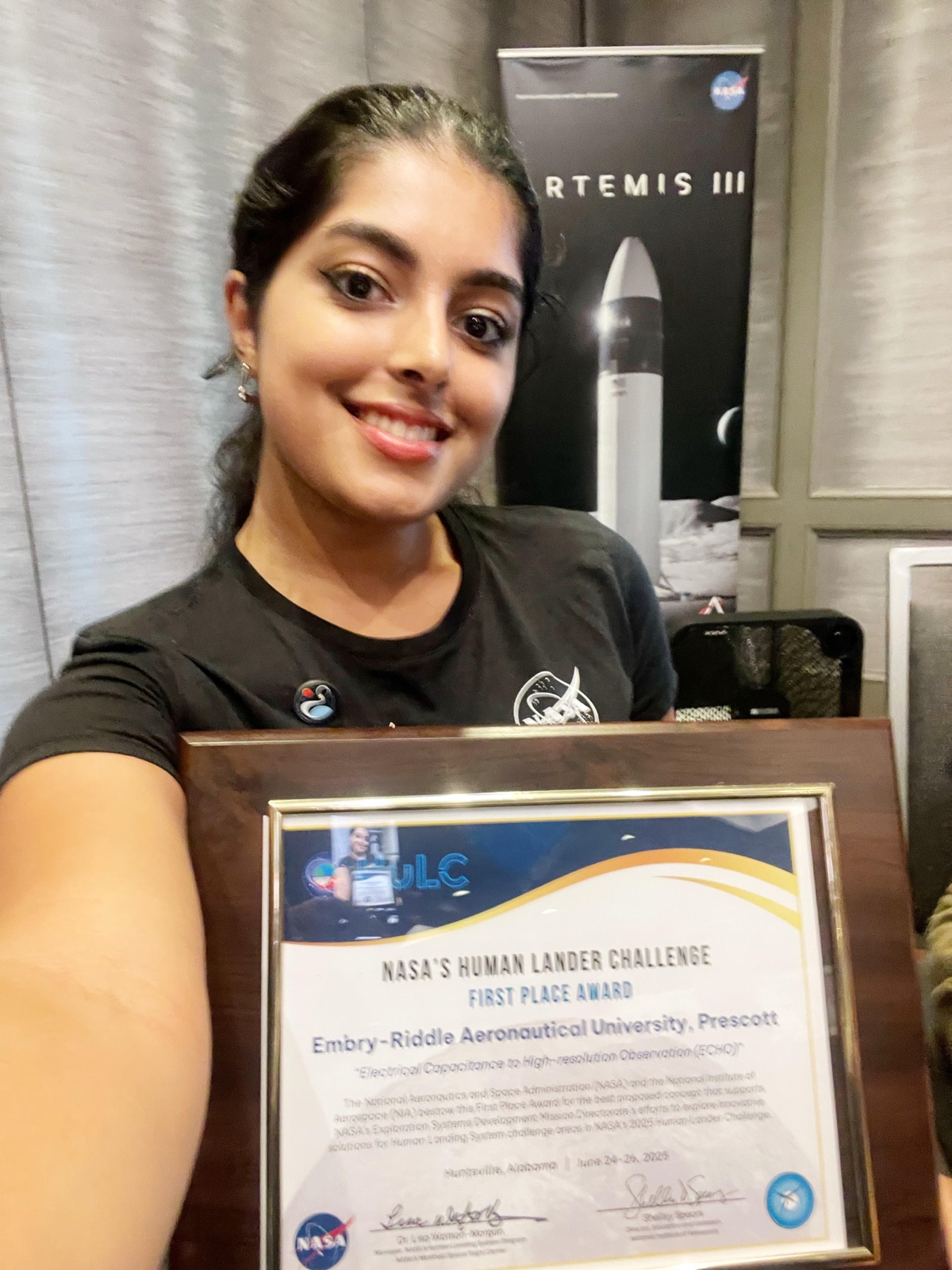
Sanaya Nichani holding NASA's Human Lander Challenge First Place Award plaque
NASA First Place Award · 2025

Overall winner, NASA's Human Lander Challenge

Presented by NASA and the National Institute of Aerospace to Embry-Riddle Aeronautical University, Prescott, for the best proposed concept in support of NASA's Human Landing System program, the lander that will carry Artemis astronauts to the Moon.

  • Project: Electrical Capacitance to High-resolution Observation (ECHO)
  • Field: 12 finalist universities, including MIT and Old Dominion
  • Prize: $10,000 grand prize
  • Where: Huntsville, Alabama, June 24–26, 2025
2026Huntsville, AL
NASA Finalist

AETHER: oxygen for a lunar habitat

Theme: environmental control and life support. One of 12 finalist teams nationwide.

2025Huntsville, AL
1st Place · Overall Winner · $10,000

ECHO: a fuel gauge that works in zero gravity

Theme: cryogenic propellant storage and transfer. Overall winner from 12 finalists, ahead of Old Dominion University (2nd) and MIT (3rd). Patent being pursued.

2024Huntsville, AL
Excellence in Systems Engineering Award

PARSEC: a landing pad that builds itself

Theme: plume-surface interaction, the inaugural year of the challenge. One of NASA's two Excellence in Systems Engineering awards.

The only team to make the finals every year. Embry-Riddle reports that PARSEC is the only team to have qualified for every Human Lander Challenge forum held so far.

Project experience

Engineering projects

Five lunar-mission projects since 2023, from lunar dust to life support to communications.

Aug 2026 – presentChief Engineer

C3 COSMIC Capstone Challenge: lunar surface rover

A rover carried to the Moon on Astrobotic’s Griffin lander to prepare the surface for a nuclear fission power reactor.

  • Running finite element analysis on new CAD designs to confirm parts survive loads from lunar regolith simulant
  • Building and testing the prototype at the Lunar Regolith Test Bed at NASA’s Marshall Space Flight Center
Aug 2026 – presentProgram Manager · NASA HuLC

Lunar communications antenna

PARSEC’s current Human Lander Challenge entry: an antenna system for surface-to-surface communication on the Moon.

  • Leading an agile team through the systems engineering life cycle
  • Running trade studies across RF, optical and phased-array options, then developing and testing the antenna through Phases A and B
Aug 2025 – Jul 2026Deputy Program Manager · NASA HuLC

AETHER: oxygen for a lunar habitat

An electrochemical system that turns the carbon dioxide astronauts exhale back into breathable oxygen.

  • Designed an original system architecture with a theoretical 94.7% oxygen yield for long lunar and Martian missions
  • Derived stakeholder and system requirements and designed a prototype to meet the oxygen yield
  • Testing the prototype with consecutive reactions in a preliminary PVC sensor setup
NASA finalist, 2026
Aug 2024 – Jul 2025Testing Officer · NASA HuLC

ECHO: a fuel gauge that works in zero gravity

Measures super-cold propellant floating in a microgravity tank by imaging it like a medical CT scan.

  • Designed an electrical capacitance tomography system with machine-learning image reconstruction
  • Validated reconstruction on an empty dewar with 3D-printed shapes, reaching 97% image accuracy
  • Co-authored the NASA technical report on the system’s development and verification
1st place, $10,000 NASA grand prize, 2025
Sep 2023 – Jun 2024Team member · NASA HuLC

PARSEC: a landing pad that builds itself

An additive sprayed into a lander’s exhaust that hardens loose lunar dust into a temporary landing pad.

  • Wrote the proposal to NASA covering the design, test plan, risks, validation and verification
  • Designed, built and tested a regolith test rig using an oxy-acetylene torch and lunar regolith simulant
Excellence in Systems Engineering Award, 2024
Professional experience

Industry and teaching

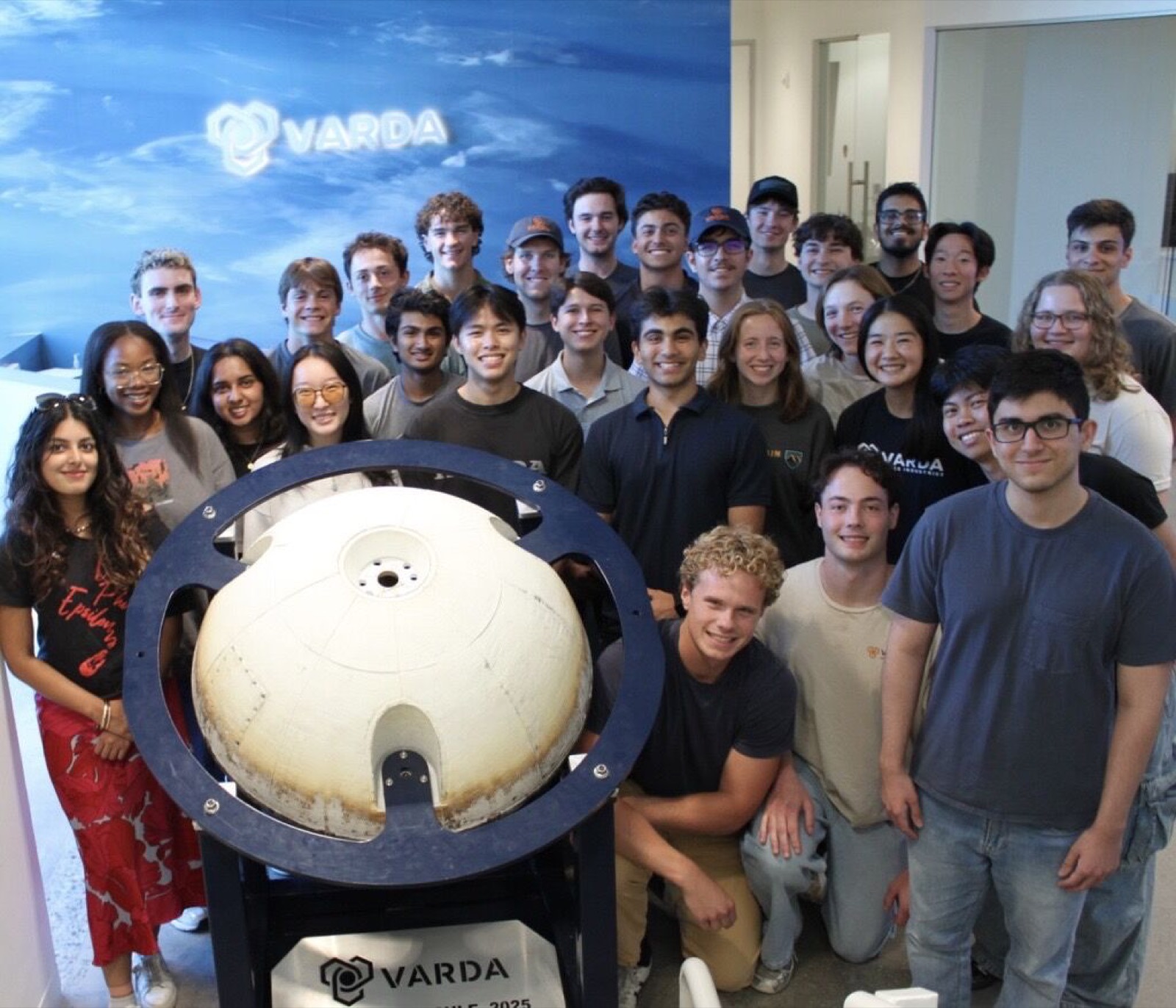
May – Aug 2026Varda Space Industries
Sanaya at Varda Space Industries

Spacecraft Engineering Intern, Safety

  • Ran job hazard assessments across 17 departments, including Propulsion, Integration & Test and Payloads: hazard identification, root-cause analysis, risk matrices and mitigation controls
  • Worked with the Thermal team to set ammonia and formaldehyde exposure limits during heat shield production
  • Designed engineering controls for hazardous chemicals such as hydrogen peroxide
  • Standardized safety training across the company
Aug 2025 – May 2026Embry-Riddle Aeronautical University

CATIA Teaching Assistant

  • Taught 60+ undergraduates CATIA part modeling, assemblies, drafting and introductory stress and strain analysis
  • Prepared students to pass the CATIA certification exams
Feb – Jun 2023Cassavant Machining Inc.

Engineering Intern

  • Supported new product integration for Raytheon’s AMRAAM missile fin production, timing machining from start to finish and providing metrics the company adopted
  • Managed production and inspection schedules for a SpaceX Raptor engine part, reducing scrap by tracing the causes of tolerance failures
  • Built a tracking system for 50+ project processes to expose scheduling bottlenecks and improve workflow visibility

Leadership and community

Astronaut Training Club Society of Women Engineers Guest, BASIS “Best in Class” podcast
Beyond the lab

50+ countries and counting

From the Hagia Sophia to the lanterns of Kyoto, Sanaya has explored more than 50 countries. She doesn’t plan to stop at Earth: her goal is to fly with NASA, and ideally to walk on the Moon.

Next destination: the Moon.

Contact

Let's build what flies next

Sanaya graduates in 2027 and is looking for roles in aerospace engineering: spacecraft systems, propulsion and propellant management, testing, and lunar exploration.

© 2026 Sanaya Nichani · sanaya.space